

If you are a post graduate student, young scientist, member of a MAB Youth Group, educator or staff working on Biosphere Reserves, and interested in water management & BRs , then, this online course is for you!
Following the successful Summer Universities organized jointly by MIO-ECSDE and the UNESCO Regional Bureau for Science and Culture in Europe for a number of years, the 2023 course takes place once again in a hybrid format and focuses on Integrated Water Management in Biosphere Reserves and other designated areas in the Mediterranean and beyond.
- The first "live"part (Phase A), was held in and around the Asterousia BR (Crete) between 18 and 24 September 2023. Read more on Phase A here.
- This call concerns the second virtual part (Phase B) that will run from 15 January to 12 February 2024.
The online course in a nutshell :
- Duration: Three weeks, starting from 15 January to 12 February 2024.
- Format: It combines asynchronous (self-paced) and synchronous sessions (weekly live meetings).
- Commitment: The total training time for learners is approx. 15 hours (~5 hours/week).
- Participants: The course is adressed (but not limitted to) MAB youth groups, Post-Graduate students, Young Researchers and Professionals working in BRs, Educators (formal and non-formal), Managers of Biosphere Reserves, Protected Areas and other designated areas. A priority is given to the European, Balkan and Mediterranean countries.
- Class size: Up to aprox. 100 online learners.
- Language: English.
- Certification: Learners who succesfully complete 80% of the course assignments will get the certificate co-signed by the UNESCO Regional Bureau for Science and Culture in Europe and the UNESCO Chair & Network on Sustainable Development Management and Education in the Mediterranean.
- Cost: Thanks to the kind contribution of the organizers the course is free of charge for all participants!
Learning goals - What will learners gain from this course?
- A better understanding of Biosphere Reserves as beacons of sustainability and ideal places to apply Integrated Water Resources Management.
- An increased understanding on the global and regional policies for effective integrated water management in BRs.
- An increased knowledge of the challenges and threats for the water resources today, and possible ways to overcome them e.g. IWRM/ICZM, Source-to-sea & Nexus approaches in water resources management; Nature based sollutions; non-convention water resources (NCWRs); etc.
- A better understanding of how Education for Sustainable Development (ESD) focusing on Water can be promoted and applied in various settings
- Access to ideas and applied examples of programmes and resources on Water & ESD
- Insights on how to apply IWRM/nexus/source-to-sea/NCWRs within their own sector of work.
- Access to a wealth of online resources.
- Networking with people with similar interests and concerns.
The course topics per week:
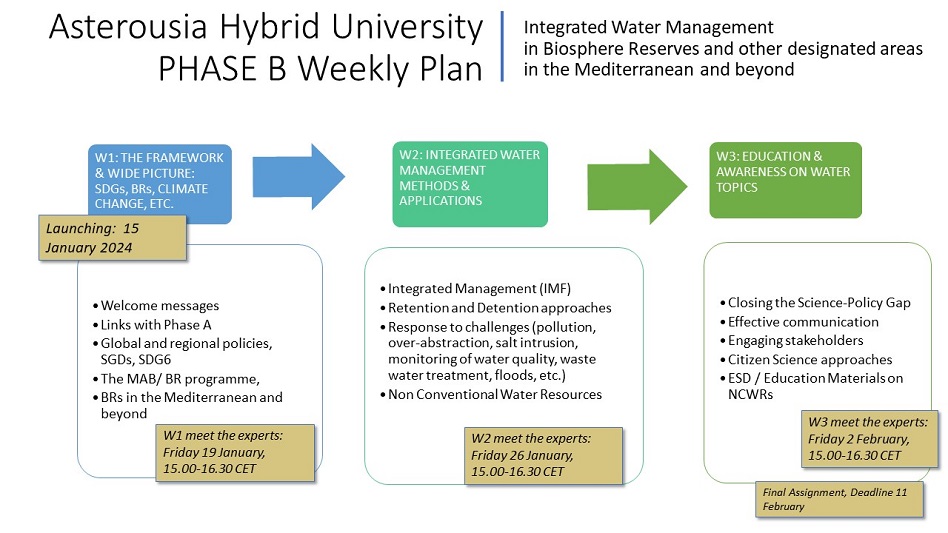
- Week 1: 15-21 January 2024, The wide picture & the challenges: The overall context; The UNESCO MAB Programme; Global and regional policies; BRs in the Mediterranean and beyond ; The SDGs & BRs; The climate & water crisis in the Mediterranean, etc.
- Week 2: 22-28 January 2024, Dealing with the challenges: Integrated Management (IMF); Retention and Detention approaches; Response to challenges (pollution, over-abstraction, salt intrusion, monitoring of water quality, waste water treatment, floods, etc.); Non Conventional Water Resources
- Week 3: 29 January - 4 February 2024 - Awareness, Education: Closing the Science-Policy Gap; Effective communication; Engaging stakeholders; Citizen Science approaches; Education for Sustainable Development (ESD) focusing on Water/NCWR.
- Week: 4-12 February 2004, days available to complete all assignments and tasks.
Format of learning content:
Every week we focus on a “cluster of topics” with a dedicated team of experts. Learners follow the course content on their own pace (asynchronously) and have the chance to interact with the experts and their co-learners in a live (synchronous) session.
Asynchronous content:
- Video lectures from experts invited
- Recordings from Phase A (Crete, 18-24 September 2024)
- Existing online videos and documentaries
- Readings: Online toolkits, Guidelines, Ppts, etc.
Synchronous content:
- Three live 1.5 hr "meet the expert" sessions where the participants can discuss with the experts on their lectures. These sessions are held via Zoom, every Friday, 15.00-16.30 (CET), and are then uploaded on YouTube, to be available to those who missed them.
Co-organizers
- UNESCO Regional Bureau for Science and Culture in Europe
- Region of Crete
- Heraclion Development Agency
- Association for the Protection of Asterousia
- The Greek National Committee of the MAB/UNESCO Programme
- UNESCO Chair and Network on Sustainable Development Management and Education at the University of Athens (UoA)
- Mediterranean Information Office for Environment, Culture and Sustainable Development (MIO-ECSDE) through the MEdIES initiative
- Global Water Partnership – Mediterranean (GWP-Med)
Secretariat
Tel. 0030 2103247490
Email: info@medies.net
W: www.medies.net
When?
Monday, January 15, 2024 12:00 AM-
Monday, February 12, 2024
Where?
Online